The Longevity Blueprint: A Systems Approach to Biological Optimization
Traditional medicine waits for the system to fail. Longevity medicine intervenes while the system works — to make it resilient against time. A comprehensive guide to biomarkers, supplementation, and peak vitality across 9 biological pillars.
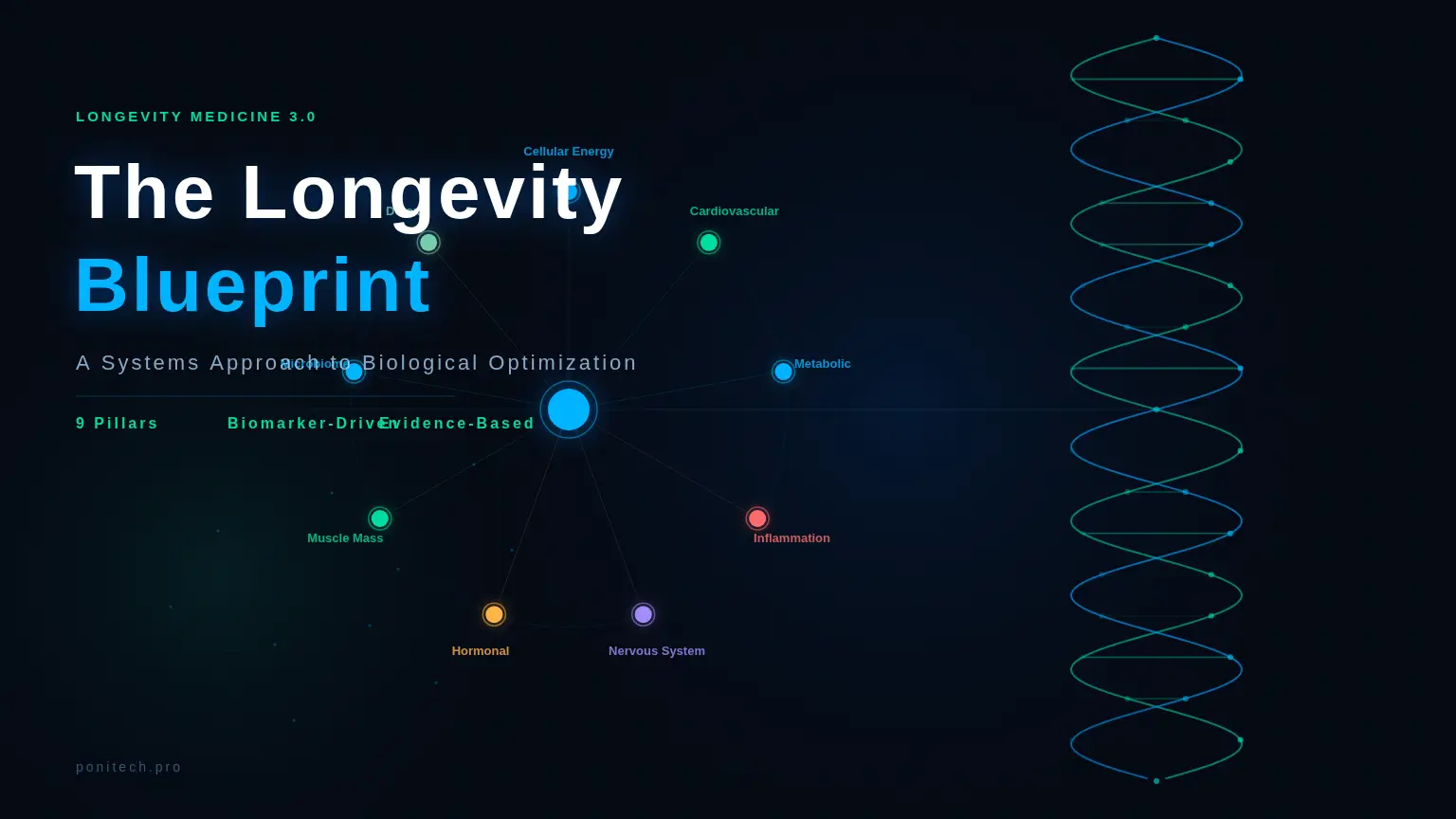
Traditional medicine intervenes when the system fails. Longevity medicine intervenes while the system still works — to make it resilient against time. The body is not a collection of isolated organs; it is a network of 9 interconnected biological pillars. Optimize all nine, and you shift the paradigm from "absence of disease" to "maximum functionality."
A core principle: Supplementation without measurement is guesswork. Test first. Optimize second.
1. Cellular Energy & Mitochondrial Health
Mitochondria are the cell's power plants. Their dysfunction is widely considered the root mechanism of aging — a process called mitophagy failure. When mitochondria degrade faster than they are replaced, energy production collapses across every organ system.
Optimal Biomarkers
| Biomarker | Optimal Range |
|---|---|
| CoQ10 | 1.2–2.5 µg/mL |
| Magnesium (Erythrocyte) | 0.85–1.1 mmol/L (more accurate than serum) |
| Ferritin | Men: 80–150 µg/L · Women: 60–120 µg/L (above 200 is pro-oxidative) |
Supplementation Protocol
- PQQ (10–20 mg) — Stimulates the biogenesis of new mitochondria
- Ubiquinol (100–200 mg) — The superior, reduced form of CoQ10 with significantly better absorption than standard CoQ10
- NAD⁺ Precursors (NMN or NR, 250–500 mg in the morning) — Support cellular repair and energy metabolism. Note: the NMN vs NR debate is ongoing; both show promise, but NMN may have a slight edge in bioavailability per recent data
- Magnesium Malate — The form most specific to energy production and muscle function
2. Cardiovascular Integrity
Cardiovascular disease remains the leading cause of death globally. The goal is not simply lowering cholesterol numbers — it is building a clean, elastic vascular system that resists plaque formation for decades.
Optimal Biomarkers
| Biomarker | Optimal Range |
|---|---|
| ApoB | < 0.6 g/L (the best single predictor of atherosclerosis) |
| Lp(a) | < 75 nmol/L (genetic marker — check at least once in your lifetime) |
| Homocysteine | 6–8 µmol/L (marker of methylation status and arterial damage) |
Supplementation Protocol
- Vitamin K2 (MK-7), 180–200 mcg — Directs calcium away from arteries and into bones where it belongs
- Citrulline Malate (6–8 g) — Drives nitric oxide production, promoting vasodilation and blood flow
- Taurine (2–3 g) — Stabilizes heart rhythm and supports healthy blood pressure
3. Metabolic Flexibility
Loss of insulin sensitivity is the "silent killer" of modern biology. Chronically elevated insulin accelerates virtually every aging mechanism: inflammation, oxidative stress, cellular senescence, and hormonal dysregulation.
Optimal Biomarkers
| Biomarker | Optimal Range |
|---|---|
| Fasting Insulin | 2–5 mIU/L (standard lab reference of "up to 25" is dangerously permissive) |
| HbA1c | 4.8–5.2% |
| Triglyceride/HDL Ratio | < 1.0 (a qualitative window into lipid and insulin health) |
Supplementation Protocol
- Berberine (500 mg with carbohydrate-rich meals) — A powerful insulin sensitizer. Important: cycle it — 8 weeks on, 4 weeks off — as prolonged continuous use may impair mitochondrial function
- Alpha-Lipoic Acid / ALA (600 mg) — Improves receptor sensitivity and acts as a potent antioxidant
- Chromium Picolinate (200 mcg) — Supports glucose metabolism and reduces carbohydrate cravings
4. Inflammation & Oxidative Stress
Low-grade chronic inflammation — termed "inflammaging" — silently destroys tissues for decades before any symptoms appear. By the time it's visible, the damage is already cumulative.
Optimal Biomarkers
| Biomarker | Optimal Range |
|---|---|
| hs-CRP | < 1.0 mg/L (the gold standard for systemic inflammation) |
| Omega-3 Index | > 8% (EPA/DHA as a percentage of erythrocyte membranes) |
Supplementation Protocol
- High-Dose Omega-3 (2–4 g EPA+DHA daily) — Use liquid or triglyceride form for best absorption; avoid ethyl ester forms
- Curcumin with Piperine — A natural blocker of pro-inflammatory cytokines; piperine increases bioavailability by up to 2000%
- NAC / N-Acetyl Cysteine (600–1,200 mg) — Precursor to glutathione, the body's master internal antioxidant
5. Nervous System & Cognitive Reserve
The brain is often the last organ people think to protect — and the first one to silently decline. Protecting cognitive reserve means managing cortisol, supporting neuroplasticity, and maintaining autonomic balance.
Optimal Biomarkers
| Biomarker | Optimal Range |
|---|---|
| HRV (Heart Rate Variability) | Higher is better — reflects adaptive capacity of the autonomic nervous system |
| Cortisol (salivary profile) | Low evening cortisol is critical for deep sleep and neural repair |
Supplementation Protocol
- L-Theanine (200 mg) — Promotes calm focus without sedation; pairs synergistically with caffeine
- Magnesium L-Threonate — The only form of magnesium clinically shown to cross the blood-brain barrier effectively
- Bacopa Monnieri — An adaptogen with evidence for memory consolidation and neuronal regeneration
6. Hormonal Architecture
Hormones are the software running the hardware. Balance matters far more than chasing peak numbers. A single hormone out of range cascades into dysfunction across multiple systems.
Optimal Biomarkers
| Biomarker | Optimal Range |
|---|---|
| Vitamin D | 100–150 nmol/L (D3 is technically a pro-hormone, not a simple vitamin) |
| Free Testosterone (Men) | Upper third of reference range for age |
| DHEA-S | Age-appropriate marker of adrenal reserve |
Supplementation Protocol
- Vitamin D3 + K2 — Always taken together with a fat-containing meal for absorption
- Zinc and Selenium — Critical cofactors for thyroid hormone conversion and testosterone synthesis
- Ashwagandha KSM-66 — The best-studied extract for regulating the HPA axis (hypothalamic-pituitary-adrenal), reducing cortisol, and supporting testosterone
7. Muscle Mass & Musculoskeletal Structure
Muscle is not just a cosmetic feature — it is an endocrine organ. It secretes myokines that regulate metabolism, insulin sensitivity, bone density, and even brain health. Muscle loss (sarcopenia) is one of the strongest predictors of early mortality.
Optimal Biomarkers
| Biomarker | Optimal Range |
|---|---|
| VO2 Max | Top 5% for your age group is the longevity target |
| Grip Strength | A direct, validated correlate of all-cause mortality |
Supplementation Protocol
- Creatine Monohydrate (5 g daily) — Not just for athletes; robust evidence for both muscle preservation and cognitive function, especially after age 40
- Essential Amino Acids (EAA) — Directly stimulate mTOR-driven muscle protein synthesis
- Collagen (15 g) + Vitamin C — For tendon and joint integrity; vitamin C is required for collagen cross-linking
8. Microbiome & Gut Barrier Integrity
The gut is where the immune system, the nervous system, and metabolism all intersect. A compromised gut barrier — "leaky gut" — allows bacterial endotoxins to enter systemic circulation, triggering the chronic inflammation described in Pillar 4.
Optimal Biomarkers
| Biomarker | Optimal Range |
|---|---|
| Zonulin (stool) | Low — a direct marker of gut barrier integrity |
| Microbiome Diversity | Assessed via sequencing (16S rRNA analysis) |
Supplementation Protocol
- L-Glutamine (5–10 g) — The primary fuel source for intestinal epithelial cells and barrier repair
- Acacia Fiber or Inulin — Prebiotic substrates that selectively feed beneficial bacteria
- Polyphenols (Resveratrol, Quercetin) — Function as prebiotics in addition to their direct antioxidant effects
9. Detoxification & Liver Regeneration
Every molecule you ingest — food, supplements, medications, environmental compounds — passes through the liver. When it is overwhelmed, toxins recirculate. Liver optimization is infrastructure-level work.
Optimal Biomarkers
| Biomarker | Optimal Range |
|---|---|
| GGT (Gamma-GT) | < 20 U/L (the most sensitive early marker of liver stress) |
| ALT / AST | Lower half of the reference range |
Supplementation Protocol
- TUDCA or Silymarin (Milk Thistle extract) — Support bile flow and protect hepatocytes from oxidative damage
- Sulforaphane (from broccoli sprouts) — The most potent known activator of the Nrf2 detoxification pathway; ideally from fresh sprouts, otherwise standardized extract
- Fisetin — A senolytic flavonoid that helps the body clear senescent ("zombie") cells. Use cyclically: 2–3 days per month at higher dose rather than daily low-dose
Implementation Protocol
Optimization is not a supplement stack. It is a system. Here is how to build it without chaos:
Step 1 — Measure first. Run a comprehensive panel twice a year. Without baseline data, you are optimizing blind.
Step 2 — Fix the foundations. Sleep (7–8 hours), nutrition (the 80/20 rule), and training (strength + Zone 2 cardio) are non-negotiable. No supplement compensates for their absence.
Step 3 — Introduce supplements one at a time. Wait 7 days between introductions. This is the only way to isolate what is actually working.
Step 4 — Retest. Biomarkers should move in the right direction within 3–6 months. If they do not, adjust the protocol.
Longevity is not about adding years to life. It is about adding life to years. A body with optimal cellular energy, clean vasculature, and low insulin is a fortress against time.
Disclaimer: This article is for informational and educational purposes only. Always consult a qualified healthcare professional before beginning any supplementation protocol or making changes to your health regimen.