The Bible for Every Developer
A Universal, Language-Agnostic Guide to Building Quality Software
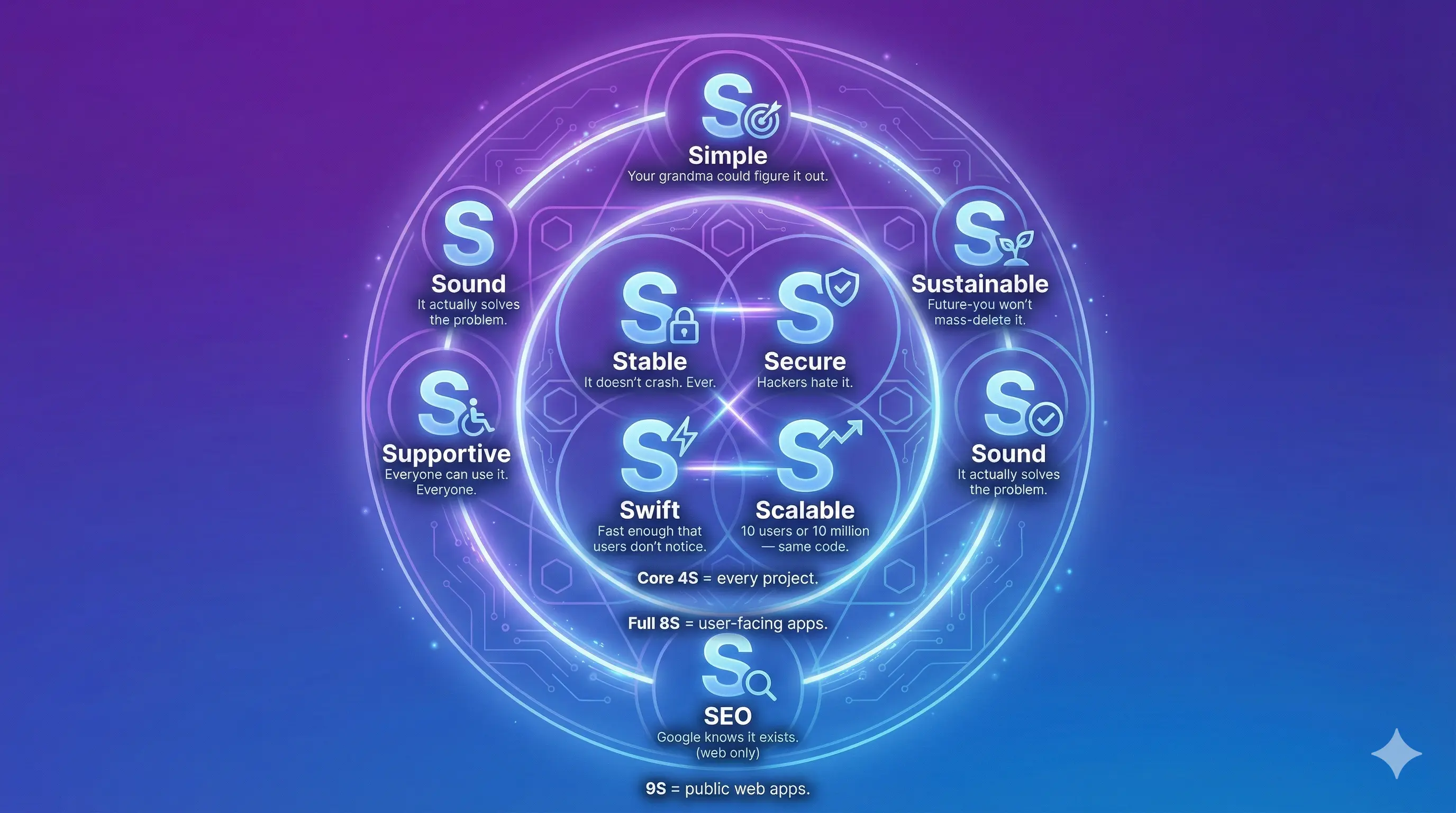
The S Framework
TL;DR
Stop memorizing dozens of "best practices." Just remember the S's:
| S-Word | What It Means | One-Liner | |
|---|---|---|---|
| 🔒 | Stable | Reliability | It doesn't crash. Ever. |
| 🛡️ | Secure | Safety | Hackers hate it. |
| ⚡ | Swift | Performance | Fast enough that users don't notice. |
| 📈 | Scalable | Scalability | 10 users or 10 million — same code. |
| 🎯 | Simple | Usability | Your grandma could figure it out. |
| 🌱 | Sustainable | Maintainability | Future-you won't mass-delete it. |
| ✅ | Sound | Correctness | It actually solves the problem. |
| ♿ | Supportive | Accessibility | Everyone can use it. Everyone. |
| 🔍 | SEO | Discoverability | Google knows it exists. (web only) |
Core 4S = every project. Full 8S = user-facing apps. 9S = public web apps.
Now go build something great. Or keep reading for the deep dive. 👇
Introduction
Let's be honest — we've all seen (or written) code that technically "works" but is a nightmare to maintain, crashes under load, or gets pwned by a script kiddie in 30 seconds.
The problem isn't that developers don't care about quality. It's that "quality" feels like a vague, hand-wavy concept. What does "good code" even mean?
The S Framework is my attempt to fix that. It's a simple mnemonic — nine qualities, all starting with "S" — that you can use as a mental checklist for any project, in any language, on any platform.
Think of it as the 10 commandments for developers. Except there's 9 of them. And they all start with S. Look, the analogy isn't perfect, but you get the idea.
Here's how it breaks down:
- Core 4S — The non-negotiables. Every piece of software needs these.
- Extended 8S — Add these four when you're building something humans will actually use.
- The 9th S (SEO) — For web apps that need to be found.
Let's dig in.
The Core 4S: The Non-Negotiables
These four apply to everything — APIs, CLIs, microservices, embedded systems, that weird Python script you wrote at 2 AM. No exceptions.
1. Stable — Reliability
Translation: Your software doesn't crash. It doesn't freeze. It doesn't randomly return wrong answers on Tuesdays.
Stability is about trust. When someone (or something) depends on your code, they need to know it'll behave the same way every single time. A "mostly working" app is like a "mostly reliable" parachute — not exactly reassuring.
The vibe: Your code should be boring. Predictably, reliably boring.
❌ Unstable Code
def get_user(user_id):
    user = database.query(f"SELECT * FROM users WHERE id = {user_id}")
    return user.name  # 💥 Crashes if user is None
✅ Stable Code
def get_user(user_id):
    try:
        user = database.query("SELECT * FROM users WHERE id = %s", [user_id])
        if user is None:
            logger.warning(f"User {user_id} not found")
            return None
        return user.name
    except DatabaseError as e:
        logger.error(f"Database error fetching user {user_id}: {e}")
        raise ServiceUnavailableError("Unable to fetch user data")
Key practices:
- Handle errors explicitly — never let exceptions bubble up unhandled
- Write tests (yes, really)
- Monitor production — you can't fix what you can't see
- Design for failure — assume everything that can break, will break
2. Secure — Safety
Translation: Your app doesn't get hacked. User data stays private. You don't end up on the front page of Hacker News for the wrong reasons.
Security isn't a feature you bolt on at the end. It's a mindset. Every input is suspicious. Every user is a potential attacker. Paranoid? Maybe. But also correct.
The vibe: Trust no one. Validate everything.
❌ Insecure Code
// SQL Injection waiting to happen
app.get('/user', (req, res) => {
  const query = `SELECT * FROM users WHERE name = '${req.query.name}'`;
  db.execute(query).then(user => res.json(user));
});

// Storing passwords in plain text? Really?
function createUser(username, password) {
  db.insert({ username, password }); // 💀
}
✅ Secure Code
// Parameterized queries — no injection possible
app.get('/user', (req, res) => {
  const query = 'SELECT * FROM users WHERE name = ?';
  db.execute(query, [req.query.name]).then(user => res.json(user));
});

// Proper password hashing
async function createUser(username, password) {
  const hashedPassword = await bcrypt.hash(password, 12);
  db.insert({ username, password: hashedPassword });
}
Key practices:
- Never trust user input — validate and sanitize everything
- Use parameterized queries (no string concatenation with SQL, ever)
- Hash passwords with bcrypt/argon2 — not MD5, not SHA1, not plain text
- Keep dependencies updated — yesterday's library is today's vulnerability
3. Swift — Speed / Performance
Translation: Your app is fast. Not "fast enough for a demo" fast. Actually fast.
Users are impatient. Studies show that a 100ms delay affects conversion rates. A 1-second delay feels sluggish. A 3-second delay and they're gone. For backend services, slow code = expensive infrastructure.
The vibe: Milliseconds matter. Optimize ruthlessly.
❌ Slow Code
# O(n²) — fine for 10 items, nightmare for 10,000
def find_duplicates(items):
    duplicates = []
    for i in range(len(items)):
        for j in range(len(items)):
            if i != j and items[i] == items[j]:
                if items[i] not in duplicates:
                    duplicates.append(items[i])
    return duplicates
✅ Swift Code
# O(n) — scales linearly, stays fast
def find_duplicates(items):
    seen = set()
    duplicates = set()
    for item in items:
        if item in seen:
            duplicates.add(item)
        seen.add(item)
    return list(duplicates)
Database Example — Indexing Matters
-- ❌ Full table scan on every query (slow)
SELECT * FROM orders WHERE customer_email = 'john@example.com';

-- ✅ Add an index first
CREATE INDEX idx_orders_customer_email ON orders(customer_email);

-- Now the same query is 100x faster
Key practices:
- Know your Big O — an O(n²) algorithm will eventually ruin your day
- Profile before optimizing — don't guess, measure
- Cache expensive operations — the fastest query is the one you don't make
- Use appropriate data structures — the right tool for the job
4. Scalable — Scalability
Translation: Your app works for 10 users. It also works for 10 million users. Same codebase.
Scalability is about planning for success. If your app goes viral tomorrow, does it survive? Or does it collapse under its own popularity? Scalable architecture means you can throw more resources at the problem without rewriting everything.
The vibe: Design for the best-case scenario, not just the current one.
❌ Non-Scalable Code
# Session stored in memory — works on one server only
user_sessions = {}  # 💀 Dies with horizontal scaling

@app.route('/login')
def login():
    user_sessions[user_id] = session_data
    return "Logged in"
✅ Scalable Code
# Session stored in Redis — works across any number of servers
import redis
session_store = redis.Redis(host='redis-cluster', port=6379)

@app.route('/login')
def login():
    session_store.setex(
        f"session:{user_id}",
        timedelta(hours=24),
        json.dumps(session_data)
    )
    return "Logged in"
Async Processing Example
# ❌ Blocking — user waits while email sends
@app.route('/signup')
def signup():
    create_user(data)
    send_welcome_email(user)  # Takes 2 seconds 😴
    return "Welcome!"

# ✅ Non-blocking — offload to background queue
@app.route('/signup')
def signup():
    create_user(data)
    task_queue.enqueue(send_welcome_email, user)  # Returns instantly
    return "Welcome!"
Key practices:
- Keep services stateless — store state in databases/caches, not memory
- Use message queues for heavy lifting — don't block the request
- Design for horizontal scaling — more machines, not bigger machines
- Cache aggressively at every layer — CDN, application, database
The Extended 8S: Building for Humans
The Core 4S keeps your app running. These next four make it actually usable. Skip these if you're building pure infrastructure, but if a human will ever interact with your software, pay attention.
5. Simple — Usability
Translation: Users can figure out your app without reading a manual. Or calling support. Or crying.
Simplicity is the ultimate sophistication. The best interfaces are invisible — users accomplish their goals without thinking about the tool. This applies to APIs too: a well-designed API is easy to use correctly and hard to use incorrectly.
The vibe: If you need a tutorial to explain it, redesign it.
❌ Complex API
// What does any of this mean?
const client = new APIClient({
  mode: 'production',
  version: 'v2',
  encoding: 'utf-8',
  timeout: 30000,
  retries: 3,
  backoff: 'exponential',
  auth: { type: 'bearer', token: process.env.TOKEN }
});

const response = await client.invoke('users', 'fetch', {
  filters: [{ field: 'id', op: 'eq', value: 123 }],
  projections: ['name', 'email']
});
✅ Simple API
// Sensible defaults, obvious methods
const client = new APIClient(process.env.TOKEN);

const user = await client.users.get(123);
UI Example — Form Validation
// ❌ Confusing — what went wrong?
<form onSubmit={handleSubmit}>
  <input name="email" />
  {error && <span className="error">Invalid input</span>}
  <button>Submit</button>
</form>

// ✅ Clear — specific, helpful feedback
<form onSubmit={handleSubmit}>
  <input
    name="email"
    aria-describedby="email-error"
  />
  {errors.email && (
    <span id="email-error" className="error">
      Please enter a valid email address (e.g., name@example.com)
    </span>
  )}
  <button>Submit</button>
</form>
Key practices:
- Provide sensible defaults — don't make users configure everything
- Show clear error messages — tell them what's wrong AND how to fix it
- Be consistent — same patterns everywhere
- Progressive disclosure — hide complexity until it's needed
6. Sustainable — Maintainability
Translation: You (or some poor soul) can understand and modify this code 6 months from now.
Here's a fun fact: you spend way more time reading code than writing it. Sustainable code is optimized for the reader, not the writer. It's boring, predictable, and well-documented. Future-you will thank present-you.
The vibe: Write code like the next maintainer is a violent psychopath who knows where you live.
❌ Unsustainable Code
// "Clever" code that's impossible to maintain
const f=(a,b)=>a.reduce((p,c,i)=>({...p,[c]:b[i]??null}),{});

// Magic numbers everywhere
if (user.role === 3) {
  if (order.total > 500) {
    discount = order.total * 0.15;
  }
}
✅ Sustainable Code
// Clear, self-documenting code
function zipToObject(keys, values) {
  const result = {};
  for (let i = 0; i < keys.length; i++) {
    result[keys[i]] = values[i] ?? null;
  }
  return result;
}

// Named constants, extracted logic
const UserRole = { ADMIN: 1, MANAGER: 2, PREMIUM: 3 };
const PREMIUM_DISCOUNT_THRESHOLD = 500;
const PREMIUM_DISCOUNT_RATE = 0.15;

function calculateDiscount(user, order) {
  const isPremiumUser = user.role === UserRole.PREMIUM;
  const qualifiesForDiscount = order.total > PREMIUM_DISCOUNT_THRESHOLD;

  if (isPremiumUser && qualifiesForDiscount) {
    return order.total * PREMIUM_DISCOUNT_RATE;
  }
  return 0;
}
Key practices:
- Use clear, descriptive names — no single-letter variables (except loop counters)
- Extract magic numbers into named constants
- Write code that reads like prose
- Keep functions small and focused — one function, one job
- Document the why, not the what — code shows what, comments explain why
7. Sound — Correctness
Translation: Your app actually solves the problem it's supposed to solve. Correctly. Every time.
You can have the fastest, most secure, most beautiful app in the world — but if it calculates taxes wrong or shows the wrong data, it's useless. Soundness means understanding the problem deeply and implementing the solution accurately.
The vibe: "Works on my machine" is not a deployment strategy.
❌ Unsound Code
# Floating point math for money — classic mistake
def calculate_total(items):
    total = 0.0
    for item in items:
        total += item.price  # 💀 0.1 + 0.2 = 0.30000000000000004
    return total

# Off-by-one in date logic
def is_promotion_active(start_date, end_date):
    today = date.today()
    return start_date <= today < end_date  # Should end_date be inclusive?
✅ Sound Code
from decimal import Decimal

# Use Decimal for money — always
def calculate_total(items):
    total = Decimal('0.00')
    for item in items:
        total += Decimal(str(item.price))
    return total.quantize(Decimal('0.01'))

# Explicit, documented business logic
def is_promotion_active(start_date, end_date):
    """
    Check if promotion is active.
    Promotion runs from start_date (inclusive) through end_date (inclusive).
    """
    today = date.today()
    return start_date <= today <= end_date
Edge Case Example
// ❌ Doesn't handle edge cases
function getFirstName(fullName) {
  return fullName.split(' ')[0];
}
// getFirstName('') → undefined 💥
// getFirstName('Madonna') → 'Madonna' ✓
// getFirstName('  John Doe  ') → '' 💥

// ✅ Handles edge cases explicitly
function getFirstName(fullName) {
  if (!fullName || typeof fullName !== 'string') {
    return '';
  }
  const trimmed = fullName.trim();
  if (!trimmed) {
    return '';
  }
  return trimmed.split(/\s+/)[0];
}
Key practices:
- Use appropriate types — Decimal for money, not floats
- Test edge cases — empty strings, nulls, boundaries, negative numbers
- Document business rules explicitly — don't leave them implicit in code
- Validate assumptions — if something "should never happen," check anyway
8. Supportive — Accessibility
Translation: Everyone can use your app. People with vision impairments. Motor disabilities. Cognitive differences. Everyone.
Accessibility (a11y) isn't a nice-to-have — it's often a legal requirement, and it's always the right thing to do. Plus, accessible design usually improves UX for everyone (try using your app with only a keyboard — it's illuminating).
The vibe: If it only works for able-bodied users with perfect vision, it's broken.
❌ Inaccessible Code
<!-- Icon button with no context -->
<div class="button" onclick="deleteItem()">
  <i class="fa fa-trash"></i>
</div>

<!-- Form with no labels -->
<input type="text" placeholder="Enter your email">

<!-- Low contrast, small text -->
<p style="color: #999; font-size: 10px;">
  Important terms and conditions
</p>
✅ Accessible Code
<!-- Semantic button with clear label -->
<button
  type="button"
  aria-label="Delete item"
  onclick="deleteItem()"
>
  <i class="fa fa-trash" aria-hidden="true"></i>
  <span class="visually-hidden">Delete item</span>
</button>

<!-- Properly labeled form field -->
<label for="email">Email address</label>
<input
  type="email"
  id="email"
  name="email"
  autocomplete="email"
  aria-describedby="email-hint"
>
<span id="email-hint" class="hint">We'll never share your email</span>

<!-- Sufficient contrast, readable size -->
<p style="color: #333; font-size: 14px;">
  Important terms and conditions
</p>
Focus Management Example
// ❌ Modal traps focus, no escape
function Modal({ isOpen, children }) {
  if (!isOpen) return null;
  return <div className="modal">{children}</div>;
}

// ✅ Proper focus management
function Modal({ isOpen, onClose, children }) {
  const modalRef = useRef(null);

  useEffect(() => {
    if (isOpen) {
      modalRef.current?.focus();

      const handleEscape = (e) => {
        if (e.key === 'Escape') onClose();
      };
      document.addEventListener('keydown', handleEscape);
      return () => document.removeEventListener('keydown', handleEscape);
    }
  }, [isOpen, onClose]);

  if (!isOpen) return null;

  return (
    <div
      ref={modalRef}
      role="dialog"
      aria-modal="true"
      tabIndex={-1}
      className="modal"
    >
      {children}
      <button onClick={onClose}>Close</button>
    </div>
  );
}
Key practices:
- Use semantic HTML — buttons for actions, links for navigation
- Add alt text to images, labels to form fields
- Ensure keyboard navigation works everywhere
- Test with screen readers — VoiceOver, NVDA, JAWS
- Maintain sufficient color contrast (WCAG AA: 4.5:1 for text)
The 9th S: SEO — Discoverability (Web Only)
Translation: People can actually find your website on Google.
For public web apps, visibility is everything. The most amazing site in the world is worthless if it's buried on page 47 of search results. SEO is part technical (can search engines crawl it?), part content (is it valuable?), and part reputation (do other sites link to it?).
The vibe: If Google can't find it, neither can your users.
❌ SEO-Hostile Code
<!-- Client-side only rendering — search engines see nothing -->
<div id="app"></div>
<script>
  // All content loads via JavaScript
  ReactDOM.render(<App />, document.getElementById('app'));
</script>

<!-- No metadata, generic title -->
<head>
  <title>Website</title>
</head>

<!-- Important content in images with no alt text -->
<img src="pricing-table.png">
✅ SEO-Friendly Code
// Next.js — Server-side rendering with metadata
export const metadata = {
  title: 'Affordable Web Hosting Plans | CloudHost',
  description: 'Starting at $2.99/mo. SSD storage, free SSL, 24/7 support.',
  openGraph: {
    title: 'Affordable Web Hosting Plans',
    description: 'Fast, reliable hosting starting at $2.99/mo',
    images: ['/og-image.jpg'],
  },
};

export default function PricingPage() {
  return (
    <main>
      <h1>Web Hosting Plans</h1>
      {/* Real content, not just an image */}
      <PricingTable plans={plans} />

      {/* Structured data for rich snippets */}
      <script type="application/ld+json">
        {JSON.stringify({
          "@context": "https://schema.org",
          "@type": "Product",
          "name": "Basic Hosting Plan",
          "offers": {
            "@type": "Offer",
            "price": "2.99",
            "priceCurrency": "USD"
          }
        })}
      </script>
    </main>
  );
}
Key practices:
- Use SSR or SSG — search engines need to see your content
- Write descriptive titles and meta descriptions for every page
- Use semantic HTML — h1, h2, article, nav, main
- Implement structured data (Schema.org) for rich snippets
- Optimize Core Web Vitals — speed affects rankings
Quick Reference: The Complete S Framework
| S-Word | Concept | Description | |
|---|---|---|---|
| 🔒 | Stable | Reliability | Consistent performance without crashes |
| 🛡️ | Secure | Safety | Protected from threats and vulnerabilities |
| ⚡ | Swift | Speed / Performance | Fast response times, efficient resources |
| 📈 | Scalable | Scalability | Handles growth without redesign |
| 🎯 | Simple | Usability | Intuitive, frictionless experience |
| 🌱 | Sustainable | Maintainability | Code that ages well without decay |
| ✅ | Sound | Correctness | Solves the right problem correctly |
| ♿ | Supportive | Accessibility | Usable by people of all abilities |
| 🔍 | SEO | Discoverability | Findable by search engines (web only) |
When to Use What
Not every project needs all 9 S's. Here's a quick guide:
| Project Type | Which S's? |
|---|---|
| Backend APIs | Core 4S + Sustainable + Sound (Simple = good DX) |
| Public Web Apps | All 9S |
| Internal Tools | Core 4S + Simple + Sustainable |
| Mobile Apps | 8S (skip SEO, but think about ASO) |
| CLI Tools | Core 4S + Simple + Sound |
| That 2 AM Script | At least try for Stable and Sound, okay? |
Conclusion
Look, software development is complicated. There are a million things to think about, a thousand frameworks promising to solve all your problems, and exactly zero silver bullets.
But quality doesn't have to be complicated.
The S Framework gives you a simple mental model: nine qualities, all starting with S, that you can actually remember when you're knee-deep in code at 11 PM trying to ship a feature.
Here's the cheat sheet one more time:
Stable · Secure · Swift · Scalable
Simple · Sustainable · Sound · Supportive
(and for the web) SEO
You don't need to nail all nine perfectly on every project. But you should consciously decide which ones matter most for your context — and then actually invest in them.
Build software that doesn't crash (Stable), doesn't get hacked (Secure), doesn't make users wait (Swift), and doesn't fall over under load (Scalable).
When humans are involved, make it easy to use (Simple), easy to maintain (Sustainable), actually correct (Sound), and usable by everyone (Supportive).
And if you're on the web, make sure people can find you (SEO).
That's it. That's the whole framework.
Now stop reading and go build something great.
The S Framework: The Bible for Every Developer
Because great software follows timeless principles.
Found this useful? Star it, share it, argue about it on Twitter. And if you think I missed an S, I'm all ears.